

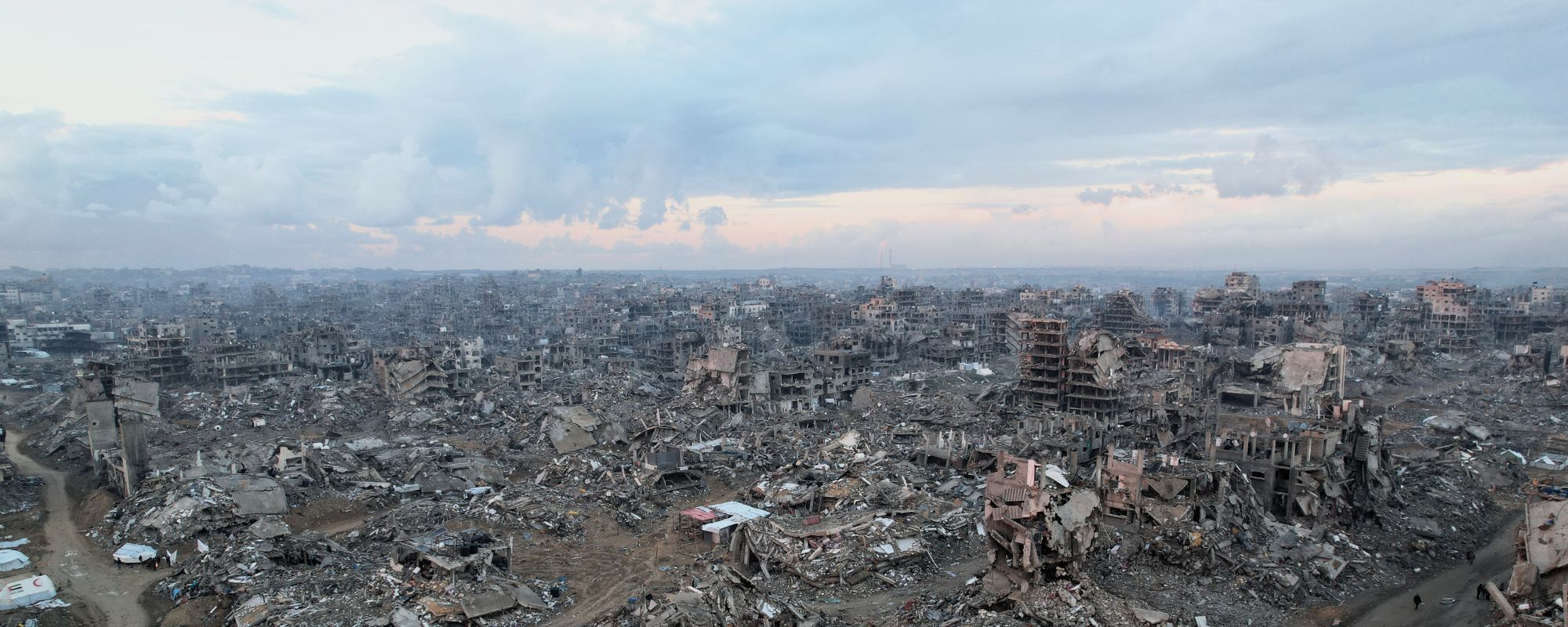
Oxfam warns after 600 days of war: Israel's mass displacement of Palestinians is wiping out Gaza
Since Israel broke the ceasefire, it has issued a displacement order essentially every other day, deporting people to isolated areas that together make up less than 20 percent of the Gaza Strip.
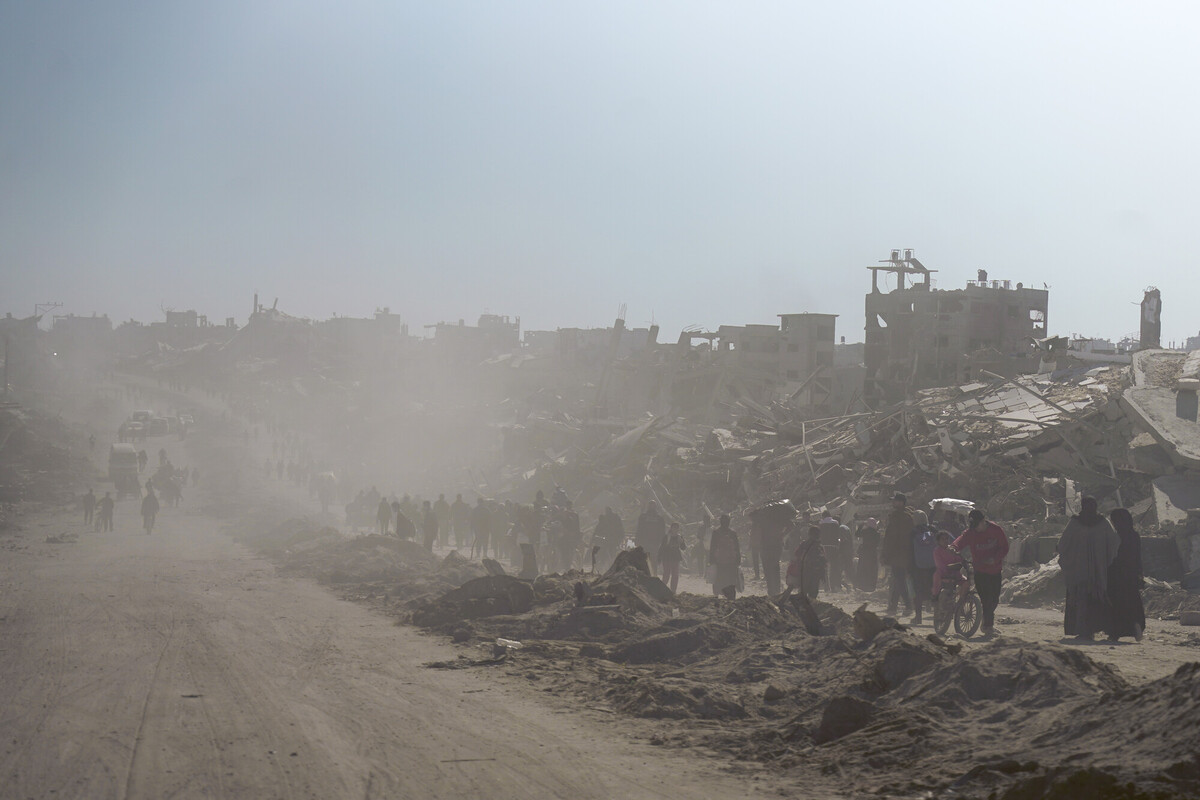
People return to what remains of their homes during the ceasefire earlier this year. Image from January 2025. Photo: Alef Multimedia Company/ Oxfam
Israel has used mass eviction orders and relentless military attacks to systematically force civilians into five demarcated zones – sandwiched between military corridors and the sea – that now make up less than 20 percent of Gaza. Combined with deliberately denying people basic necessities, this reveals a strategy that is not about targeting combatants, but dismantling and obliterating Gaza itself, Oxfam warns today.
New analysis by Oxfam shows that since breaking the ceasefire on March 18, Israel has issued over 30 forced displacement orders – almost one every two days – displacing people from 68 out of 79 areas, some multiple times. These areas, together with the expanding “no-go” Israeli military zones, make up over 80 percent of the Gaza Strip. The cumulative effect is a de facto confinement of the population in overcrowded enclaves lacking basic infrastructure.
The sheer scale and relentless frequency of these orders have made it virtually impossible for people to find refuge. The pattern suggests not an attempt to neutralize a threat, but a deliberate campaign to dismantle and depopulate Gaza – a process of forced displacement that is a war crime.
At the same time, Israel has expanded its military presence along five so-called “security corridors” – Philadelphia, Murag, Kisufim, Netzarim and Mefalsim – that run horizontally across the Gaza Strip. These corridors effectively divide the territory into five isolated zones, separating the north from the south and preventing civilians from moving within what is already a tightly confined space.
“ For over 600 days, Israel has said it is targeting Hamas, but it is civilians who have been rounded up, bombed and killed en masse every day. The displacement orders follow a clear and calculated pattern: using the threat of violence to herd civilians into ever-shrinking containment zones. This is not counterterrorism, as Israel claims – it is the systematic emptying of Gaza by militarized force into enclaves of detention. ”
Bushra Khalidi, Policy Officer for Oxfam in Palestine and Israel
Israel’s displacement orders followed by military attacks clearly demonstrate a reality that is consistent with what Israeli officials have openly stated: plans to take control of Gaza and establish militarized “humanitarian” hubs, where civilians will receive aid from private contractors under armed guard. Oxfam and other international bodies have firmly rejected these proposals as coercive, politicized, and incompatible with humanitarian principles.
Between 15–20 May alone, over 160,000 people were displaced – part of a total of almost 600,000 people displaced since 18 March, many of whom have been forced to flee repeatedly.
One of the most significant recent orders, issued on May 20, covered 34.9 km², approximately 10 percent of Gaza’s land area, uprooting 150,000–200,000 people in northern Gaza’s Beit Lahiya and Jabalia. The impact of such orders on already displaced populations has been devastating.
“ In any other conflict, civilians would have ways to escape to nearby areas or countries. In this case, the Palestinians are completely trapped under an iron-clad siege and are facing the sea. ”
Bushra Khalidi, Policy Officer for Oxfam in Palestine and Israel
“ Imagine trying to move with four children or an elderly parent in the middle of the night, with no transportation and nowhere to go. People are so exhausted that many would rather face death than flee again. ”
Fidaa Alarajm Oxfam's gender equality advisor in Gaza, who has been displaced with her family several times.
The so-called “known shelters” designated by Israel – primarily Al-Mawasi – are little more than dust-filled camps that offer no real protection. Al-Mawasi, a barren coastal strip of about 40 square kilometers that was home to 7,000 people before the war, has now been designated as a place to which hundreds of thousands are being displaced. Despite its designation as a safe zone, it has repeatedly come under Israeli attack.
Almost all of the remaining areas where civilians are being forcibly displaced – which constitute only 20 percent of Gaza’s territory – are completely devoid of clean water, sanitation, healthcare and basic infrastructure. This reality is a direct violation of international humanitarian law, which obligates Israel as the occupying power to ensure that displaced civilians have adequate shelter, hygiene and protection.
“ This campaign of total annihilation and bloodshed must end. It is long past time for Western governments and other influential powers to move beyond rhetoric and apply meaningful pressure on Israel to lift the siege and abandon any plans to annex Gaza. ”
Bushra Khalidi, Policy Officer for Oxfam in Palestine and Israel
" It is therefore also important not to delay the review of the EU's association agreement with Israel but to act now. It is time for the EU to react. There is no time left. Every second of delay costs lives. We simply do not have time for the EU to sit and negotiate. If the EU as a bloc fails to repeal the agreement with Israel, EU countries must bilaterally terminate these agreements. Anything else is complicity. "
Bushra Khalidi, Policy Officer for Oxfam in Palestine and Israel
“ Peace cannot be negotiated on the ruins of Gaza, or on stolen Palestinian land. Ahead of the two-state solution summit planned in New York next month, world leaders must call on Israel to lift the siege and abandon all plans to annex Gaza and the West Bank. What is at stake is not just the future of Palestine, but the integrity of every nation that claims to uphold international law. ”
Bushra Khalidi, Policy Officer for Oxfam in Palestine and Israel
Background
- On May 15, Oxfam Sweden published an open letter to Prime Minister Ulf Kristersson . So far, over 51,000 people have signed it urging the government to take action for Gaza.
- Oxfam has analysed all evacuation orders issued by Israel in Gaza between 18 March and 26 May 2025, which amounted to 31 orders, an average of one order every 2.3 days. On several days, Israel issued multiple orders within 24 hours.
- According to UNOCHA, all 25 municipalities in Gaza’s five governorates are affected – either partially or fully – by evacuation orders or militarized zones. Only 11 neighborhoods out of 79 within these governorates have not been subject to evacuation orders.
- To assess the extent and timing of Israel’s evacuation orders in Gaza, Oxfam has relied on a number of sources, including the UNOCHA website and the official Israel COGAT GAT FB page . According to the OCHA evacuation orders website, 81% of the Gaza Strip is under evacuation orders or military zones as of 18 March 2025.
- Approximately 81% of the Gaza Strip (365 square kilometers) is currently either under evacuation orders or classified as a militarized zone. This means that only 19% (approximately 70 square kilometers) of Gaza remains outside these two categories, as illustrated in this UNOCHA map .
- Evacuation order data was retrieved on May 20, 2025 from the Joint Humanitarian Operation Center (JHOC) Update #6.
- Between 1:00 p.m. on May 20 and 1:00 p.m. on May 21, an estimated 22,548 people were displaced. The total number of displaced since May 15 is 161,506 and the estimated number of displaced since March 18 is 599,104 people.
Source: The Site Management Cluster Update (15-21 May 2025).
- Al-Mawasi has an area of about 41 square kilometers (15.83 square miles) that lacks critical infrastructure and services, according to the UN Office for the Coordination of Humanitarian Affairs (OCHA). September 10, 2024.
- According to Article 49 of the Fourth Geneva Convention (1949), an occupying power may evacuate civilians only for their own safety, or for imperative military reasons, and even then the measure must be temporary and allow for safe return as soon as hostilities have ceased; at the same time, Articles 55 and 56 oblige the occupying power to ensure that displaced persons have adequate food, medical care, hygiene and shelter.
Länken är kopierad