
New report highlights Swedish climate inequality
Swedish emission reductions since 1990 have been achieved thanks to low- and middle-income earners. The richest ten percent of the population have barely contributed to emission reductions at all
Today, Oxfam is releasing a review of climate inequality in Sweden.
The report is based on research conducted together with the Stockholm Environment Institute. The methodology and previous findings were published in "Carbon Inequality Era", an assessment of the global distribution of consumption emissions among individuals between 1990 and 2015.
The new report examines Swedes' carbon dioxide emissions linked to consumption between 1990 and 2015, a period during which income inequality increased and Sweden's total consumption emissions decreased by eleven percent. The report shows an inequality in consumption emissions between different income groups:
- The total carbon emissions of the 50% with the lowest income decreased by 16%, while the emissions of the middle 40% decreased by 12%. In contrast, the top 10% of income earners did not change their total emissions significantly - only by one percent. The richest 1% increased their emissions by 11%.

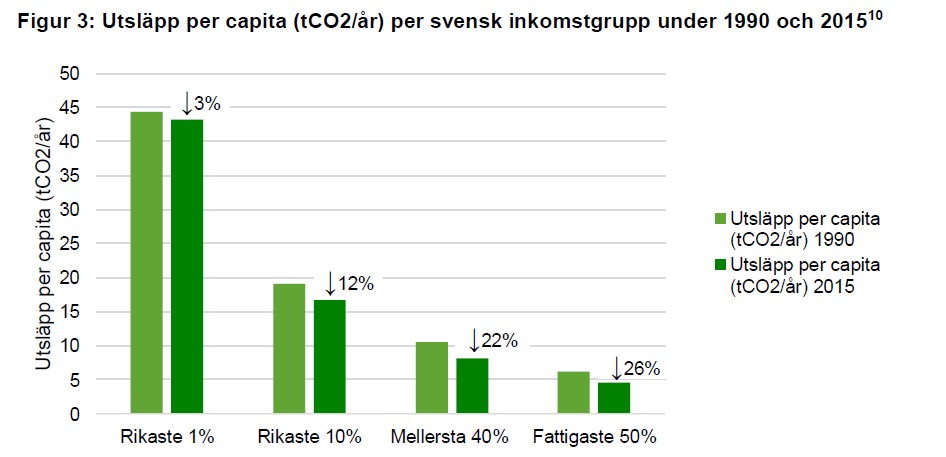
- Per capita emissions decreased for all groups, but even these were very unevenly distributed, with the richest one percent barely reducing their per capita emissions at all.
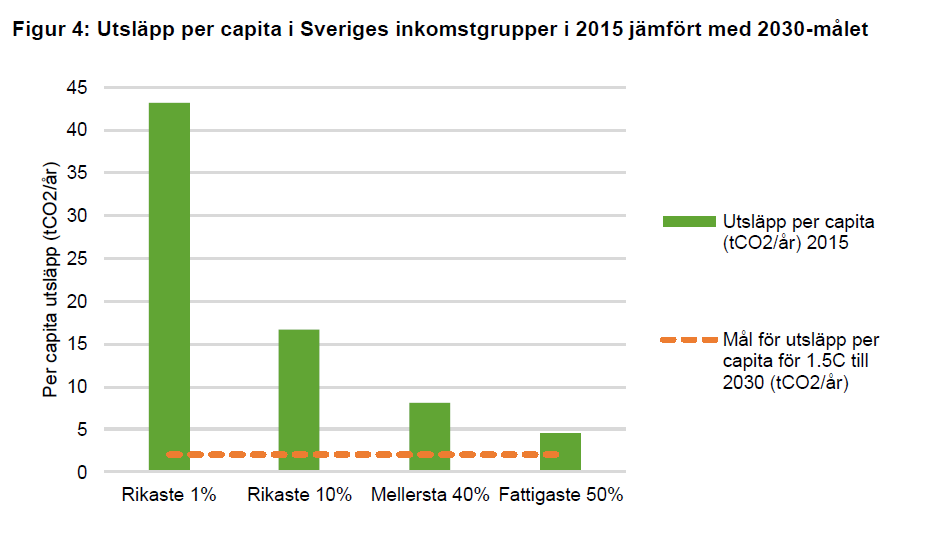
- To meet the 1.5-degree target, the richest one percent in Sweden need to reduce their emissions by 95 percent in less than ten years, from 43 tons per person per year Emissions for the richest 10 percent need to be reduced by about 87 percent from about 17 tons per person per year. The per capita reduction rate for this group needs to be about 20 times faster than between 1990 and 2015. In contrast, those with the lowest income need to slightly more than halve their emissions from around 4.5 tons per person.
Robert Höglund, Head of Communications at Oxfam Sweden, says:
"Climate inequality is high both globally and in Sweden. Our consumption is unsustainable and unequal. Sweden now needs to introduce targets and instruments that ensure that both total emissions go down to sustainable levels and that those who emit the most also do the most."
The report points out that the biggest difference between income groups is that high-income earners travel more. Air travel and driving account for half of the emissions of the Swedes who emit the most carbon dioxide. The fact that Swedes are buying bigger and heavier cars, such as SUVs, is also part of the problem.
One example of a policy instrument that takes into account the fairness aspect highlighted in the report is a fee and dividend: an additional fee on particularly emission-intensive services and goods - such as on air travel and heavy passenger cars - could be introduced, with the revenue then distributed equally to the population. Those with high emissions would pay more in fees than they get back, but those with low emissions would get more money in their wallets. Such a measure could both reduce emissions by providing economic incentives to emit less, and increase climate justice by making those with high emissions pay more. A variant of this has been introduced in Canada.
Oxfam also points out that Sweden and other countries with historically high emissions also have a responsibility to pay to counteract the effects of warming. In the report, Oxfam calls for low-income countries to have access to climate finance to build their economies in a sustainable way and to be supported in dealing with the effects of the climate crisis through climate aid, and for Sweden to provide its climate aid in addition to the regular aid of one percent.
Oxfam also calls on Sweden to ensure an equitable climate transition within the country, taking into account that those with the highest emissions must also reduce their emissions the most in percentage terms, and to set an overall target that ensures that the climate impact of consumption is close to zero or net zero by 2050 at the latest.
Länken är kopierad